

Most engineering organisations bought their first AI coding tools as seats: a fixed price per developer per month, budgeted like any other licence. During 2026 several widely used tools, including GitHub Copilot, Cursor and Claude Code, moved to usage-based billing, with an included allowance per seat and a metered charge beyond it. The cost of a coding agent now depends on how each engineer uses it, and the budget behaves like a cloud bill rather than a licence.
That changes what engineering and finance leaders need to watch. The useful questions are no longer how many seats are assigned or how many people logged in. They are who is spending, on what work, and whether that work reaches production in better shape or more quickly than it did before.
In short: treat coding-agent spend as a usage budget with a seat floor. Read the spread of spend across engineers, not the average. Measure value at the level of merged changes that clear a quality bar and the delivery measures your teams already track, and count the review and rework the agent creates. Compare the cost of the additional work with what it would have cost without the agent. Set budgets by team with alerts and an exception route, rather than per-person caps that discourage the engineers who get the most from it.
Key takeaways
- GitHub Copilot, Cursor and Claude Code now combine a seat with included usage and a metered charge beyond it, and each gives administrators budget or spend-limit controls. The seat price is a floor, not the cost.
- Spend is usually concentrated in a minority of engineers. An average per engineer hides the distribution that matters for budgeting and for understanding where value comes from.
- Usage, tokens and accepted lines measure activity. Merged changes that pass review and stay in production, and team delivery measures, are closer to value.
- A cost per merged change is only useful when it includes review and rework time and is compared against a baseline. The cost of the additional changes is often several times the average.
- Usage leaderboards reward the meter. Budgets by team, with alerts, a sensible default model and a monthly review of the heaviest use, control cost without punishing adoption.
The meter has moved
Three announcements from 2026 show the same shift.
The details differ, but the structure is the same: a seat that buys an allowance, a pooled or metered tail beyond it, and controls that let an organisation cap or alert on spend. Microsoft is moving the same way for Microsoft 365 Copilot, as The Seat Is No Longer the Only Meter sets out. For budgeting, the seat count gives the floor. The tail depends on model choice, how long agents run, and how many engineers use agents for multi-step work rather than completions.
The practical consequence is that the coding-tool budget now needs the same treatment as any usage-priced service: a forecast with a range, owners for the variance and a monthly look at what drove it. The AI budget stress test shows how quickly a usage line moves when adoption and intensity both rise. InterpretationRead the distribution, not the average
The vendor averages above describe a typical engineer. Budgets are set by the whole distribution, and in most teams spend is concentrated.
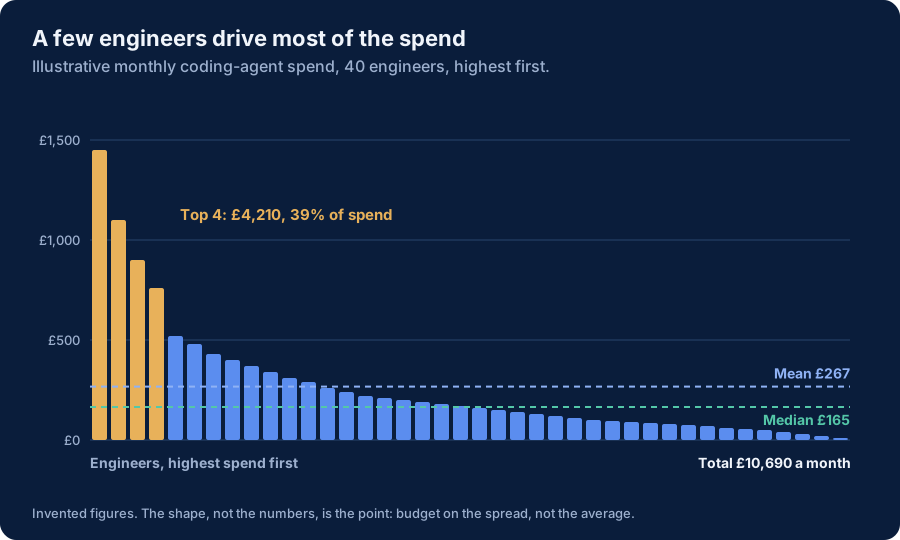
Three things follow.
- Budget on the distribution. A per-head budget set at the mean will be exceeded by the heaviest users every month and leave most of the team well under it. A team budget set from the total, with the expected spread, is more stable.
- Look at the heaviest users first, without assuming waste. Heavy use can mean an engineer has found work where agents pay off, such as test generation, migrations or long refactors. It can also mean long sessions left running on an expensive model. The way to tell is to look at what the spend produced, not at the spend alone.
- Expect the distribution to move. As more engineers move from completions to agents that plan and run multi-step tasks, the middle of the distribution rises. Re-forecast from observed usage each quarter rather than from the first month after rollout.
Uber's experience is the warning case: an annual AI coding budget reported as spent in four months, after internal leaderboards ranked usage. When AI Usage Outruns the Budget tells that story.
Some organisations are now responding with per-person limits. Bloomberg reported on 4 November 2026 that Apple had cut some engineers' daily AI allowance from $300 to $200 in October and might cut it further to $100, with exemptions granted by executives. Some staff said few people used the full $300 (MacRumors, reporting Bloomberg; register entry ER108). A limit set near the top of the distribution cuts only the heaviest users, which is why the guardrails below put team budgets first. Token Budgets Are Not a Value Strategy works through what a flat cap does to two engineers on the same team. Added 5 November 2026.
Which measures hold up
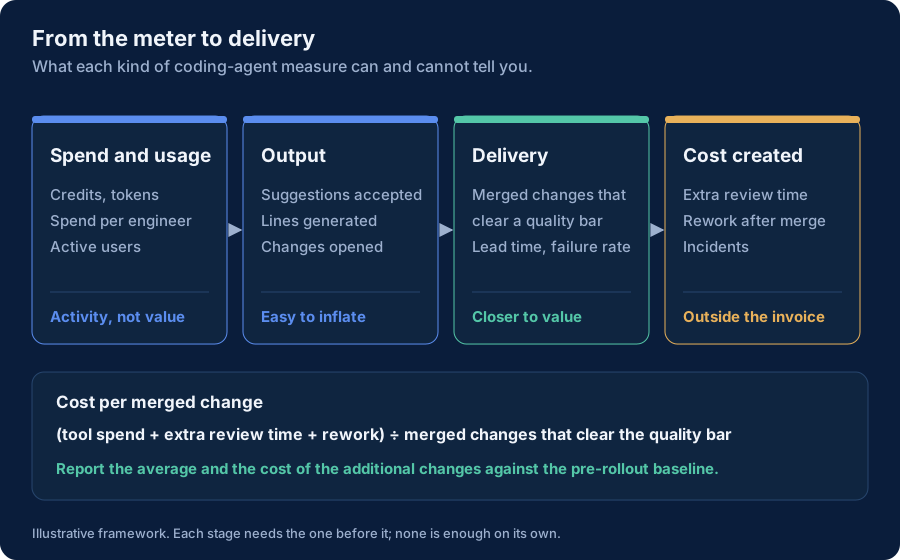
Coding tools produce a lot of data. Most of it measures activity. The distinction ladder is a useful check: a metric on a lower rung is not evidence for a higher one.
| Measure | What it tells you | How it misleads |
|---|---|---|
| Seats assigned, active users | Reach of the tool | Says nothing about the work done with it. See AI adoption |
| Credits, tokens or spend per engineer | Cost and intensity of use | High use can be productive or wasteful; the number cannot tell you which |
| Suggestions accepted, lines generated | Output of the tool | Easy to inflate, and more code is not more value |
| Merged changes that clear a quality bar | Work that reached the codebase and survived review | Change size can shrink as work is split; check the median size alongside the count |
| Lead time, deployment frequency, change failure rate, recovery time | Team delivery performance | Team-level and affected by many other changes; needs a before-and-after or comparison group |
| Review time and rework on agent-written changes | Cost the agent creates for other people | Sits outside the tool invoice, so it is often left out |
What the Engineering Evidence Says About AI Coding Value explains why the published studies point in different directions. The same caution applies inside an organisation: task speed, delivery performance and how productive developers feel are different claims, and only the second is a business outcome.
Cost per merged change, done carefully
A unit cost gives finance and engineering a shared number. For coding agents the most usable unit is the merged change that clears a quality bar: it passed review and was not reverted or substantially reworked within an agreed window, such as 14 days. That definition is a quality floor, and it matters more than the formula.
The cost side should include three things: the tool spend, the extra review time agent-written changes need, and the rework on changes that fail after merging. The method is the same as for any cost per outcome.
The KPI library carries this measure as Coding-Agent Cost per Merged Change. Two checks keep the number honest. First, if the median change size falls, the count of changes rises without more work being done, so state the size alongside the count. Second, a change in count only becomes value when it shows up in something the organisation cares about: features shipped, defects or incidents avoided, a backlog cleared, or engineering capacity moved to work that was previously unstaffed. Where the Productivity Gain Goes explains why time saved often does not become money, and the AI benefits register is a place to record what it does become.
Leaderboards measure the meter
Ranking engineers by usage tells them that usage is the goal. It is a clear case of the problem described in The Token Is the Meter, Not the Value. If an organisation wants to recognise good use, it can share examples of work an agent made possible, with the cost and the result side by side.
Guardrails that keep adoption
Controls should limit runaway cost without making engineers ration a tool that helps them. Most of what follows is available in the administration settings of the tools themselves.
- Budget by team or cost centre, not per person. A pooled team budget absorbs the natural spread. Per-person caps are better used as a high backstop than as the main control.
- Alert before you cap. Alerts at, say, 50%, 80% and 100% of the monthly team budget give time to look at what is driving spend. A hard cap mid-sprint stops work.
- Set a sensible default model. Make a capable lower-cost model the default and premium models available when the task needs them. The Economics of Model Selection explains the principle: use the cheapest setup that clears the quality floor.
- Review the heaviest use monthly, with the engineering lead. The aim is to find out which work pays and which sessions were waste, then share the first and fix the second.
- Keep an exception route. A migration or a large refactor may justify a month of heavy use. A quick way to raise a team budget for a defined piece of work is cheaper than the delay a hard limit causes.
- Show spend back to teams. A monthly view of spend by team, beside merged changes and delivery measures, is usually enough accountability. Where coding agents run on internally hosted models, the same showback applies to shared capacity; see Who Pays for Idle GPUs?.
A monthly review for engineering and finance
A 30-minute monthly review is enough for most organisations. It needs one page with:
- Spend by team against budget, with the distribution across engineers.
- What drove any variance: more users, heavier use, model mix or new kinds of work.
- Merged changes that cleared the quality bar, with median change size, against the baseline.
- Review and rework hours on agent-written changes.
- Delivery measures for the teams with the highest and lowest spend.
- One or two examples of work the agent made possible, and one example of waste.
The output is a decision for each team: carry on, adjust the budget or default model, or look harder at whether the use is paying off. That follows the same scale, hold, redesign or stop logic the site applies to any AI investment.
Questions readers ask
How much does a coding agent cost per developer?
It depends on the tool, the plan, the models used and how the agent is used. Seat prices are a floor. Anthropic reports an average for Claude Code across enterprise deployments of $150 to $250 per developer per month, and GitHub's Business and Enterprise seats include $19 and $39 of usage before metered charges begin. Your own figure will come from a pilot: measure a month of use for a representative group and look at the spread, not just the average.
What is a good measure of AI coding ROI?
There is no single measure. The most defensible combination is the cost of the additional merged changes that clear a quality bar, including review and rework time, set against team delivery measures before and after rollout, and against what the additional work was worth. Usage, accepted suggestions and self-reported time saved are inputs, not returns. How to Measure AI Value gives the general method.
Should we cap coding-agent usage?
Cap at team level with alerts first, and keep per-person caps as a high backstop. Hard per-person limits tend to hit the engineers who use agents most effectively, in the middle of their heaviest work. Use the monthly review to decide whether a team's budget should rise or fall.
How should coding-agent costs be allocated to teams?
Most tools now report spend by user and allow budgets by cost centre, so direct allocation by team is straightforward for vendor-hosted tools. Where agents call internally hosted models, the cost of the shared capacity needs allocating as well. Who Pays for Idle GPUs? covers that case.
Tools and templates
Cost per successful outcome calculator
Browser tool. Compare up to four model setups on what each successful outcome costs, including the people who fix failures. Runs in your browser; nothing is sent anywhere.
AI budget stress test
Browser tool. Test whether an AI case still meets its hurdle if prices rise, demand grows, or both. Runs in your browser; nothing is sent anywhere.
AI Benefits Register
Excel template. Track each benefit by type, owner and booking record, so only value that has reached an accepted record counts as realised.
Sources: GitHub, "GitHub Copilot is moving to usage-based billing" (27 April 2026); Cursor, "Improvements to Teams Pricing" (1 June 2026); Anthropic, Claude Code documentation, "Manage costs effectively" (read 26 October 2026). Evidence on productivity and delivery is set out, with sources, in What the Engineering Evidence Says About AI Coding Value.