

Key takeaways
- In McKinsey's 2026 State of AI survey, 80% of respondents said AI had improved their own productivity. 37% said AI had any effect on their organisation's EBIT, essentially the same share as a year earlier.
- The two figures are not contradictory. They measure different things at different points in a chain, and value is lost at each step between them.
- The chain has four steps: what was observed, what is left after checking and rework, what was converted into money or measured output, and what was booked. Most AI programmes measure only the first.
- The leak that matters most is conversion. Time saved by individuals turns into financial value only when management releases it, redeploys it to measured work, or changes a budget. That is a management decision, not a property of the tool.
Two numbers from the same survey
McKinsey's survey of 1,719 people in 97 countries, fielded in May and June 2026, found that 80% said AI had improved their individual productivity. It also found that 44% said AI was scaling across their organisation, up from 38% a year earlier. Yet 37% reported any EBIT impact from AI, against 39% in 2025, and the share of high performers, attributing 5% or more of EBIT to AI and calling the impact significant, held at about 6% (McKinsey, 25 August 2026).
Adoption rose. Individual experience is positive. The enterprise result did not move. This is the AI value gap in one survey, and the reason is visible if the gain is followed from the person to the accounts.
Following the gain
This publication uses the claim chain from the Tokenomics Foundation's value classification: Observe, Net, Convert, Book. Each step is a place where a productivity gain can be lost.
Observe: the gain people report
The 80% figure is a perception. Perception is a weak measure of AI productivity, and it can be wrong in direction as well as size. In METR's randomised trial of experienced open-source developers, tasks took 19% longer with AI allowed, while the developers expected to be 24% faster and afterwards still believed they had been about 20% faster (METR, July 2025). One study of one group does not generalise, but it shows why self-reported time saved should not be the starting number.
The UK government's cross-department Microsoft 365 Copilot experiment found users reporting an average of 26 minutes saved a day, and could not identify how the time saved was spent (UK government). The observation was real. What happened next was not recorded.
Net: the gain after checking and rework
AI output has to be checked, and some of it has to be redone. That time comes off the gain. In one 2026 survey, finance teams said they spend 26% of their working week verifying or correcting AI output (Datarails, 6 October 2026, vendor research). Not all of that is new work, and not all of it is caused by AI. But a person who saves an hour drafting and spends twenty minutes checking has saved forty minutes, and the twenty minutes often falls on someone else. The Cost of Verification covers how to price it.
Convert: the gain that becomes money or measured output
Released time is potential value. It becomes financial value in one of three ways: the cost is removed, the time is redeployed to work whose output is measured, or a constraint on throughput is lifted. If none of these happens, the time is absorbed. People finish earlier, take more care, or do work nobody measures. That may be good for them and for quality. It does not reach EBIT.
The survey evidence shows how rarely conversion is planned. McKinsey found that 39% of respondents expected AI to reduce total headcount in the coming year, while 14% said it had contributed to a workforce decline in the past year (register entry ER66). At a McKinsey presentation reported by Computer Weekly, 73% of high performers had redesigned workflows around AI, against 25% of other organisations (Computer Weekly, 30 September 2026, secondary report). Redesign is how saved time is pointed at measured work. Most organisations have not done it.
Book: the gain that lands in the accounts
Even converted value reaches the profit and loss account only if a budget, a cost line or a revenue line changes. A team that handles 20% more volume without overtime has created value, but it shows up as cost avoided, which is real and rarely booked. A team whose budget is cut by the value of the time saved has booked it. Finance has to decide which is being claimed, and the AI Benefits Register keeps the categories apart.
An illustrative chain
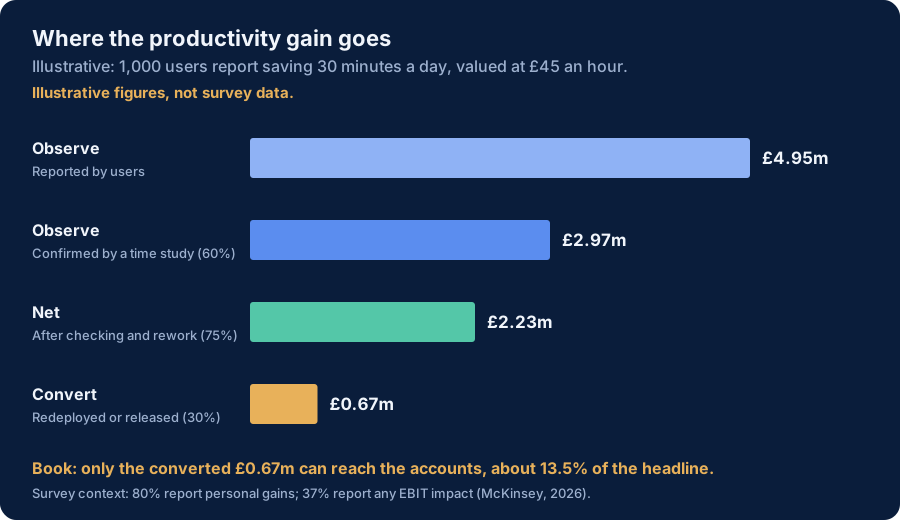
Illustrative figures, not survey data. An organisation gives an AI assistant to 1,000 knowledge workers. Users report saving 30 minutes a day over 220 working days. Time is valued at £45 an hour.
| Step | Assumption | Hours a year | Value |
|---|---|---|---|
| Observe | 30 minutes a day reported by 1,000 users | 110,000 | £4,950,000 |
| Observe, measured | A sampled time study confirms 60% of the reported saving | 66,000 | £2,970,000 |
| Net | Checking and rework take a quarter of the measured saving | 49,500 | £2,227,500 |
| Convert | 30% of net time is redeployed to measured work or released | 14,850 | £668,250 |
| Book | Booked only where a budget or output target changed | Depends on finance | Up to £668,250 |
The headline is £4.95 million. The defensible figure is about £0.67 million, roughly 13.5% of it, and only if the conversion is planned and the booking agreed. Every assumption in the table can be changed. The point is that each step has its own assumption, and most business cases make only the first one.
What to do about it
- Measure the workflow, not the person. Count throughput, cycle time and quality for a defined piece of work, before and after, ideally against a holdout group. See How to Measure AI Value.
- Price the checking. Record who reviews AI output and how long it takes, including review that has moved to colleagues or customers.
- Decide conversion before rollout. Name what the saved time is for: a cost to release, a backlog to clear, a volume increase to absorb. If nobody can say, expect it to be absorbed.
- Agree the booking with finance. Decide in advance whether the claim is cost reduction, cost avoidance or growth, and where it will show.
- Report all four numbers. Observed, net, converted and booked, side by side. The ratio between the first and the last is a measure of how well the programme is managed.
Sources
- McKinsey, "The state of AI in 2026: On the road to ROI", 25 August 2026.
- Computer Weekly, "Token bills to push most enterprise AI workloads onto open-weight models", 30 September 2026. Source of the workflow redesign figures, from a McKinsey presentation.
- METR, "Measuring the Impact of Early-2025 AI on Experienced Open-Source Developer Productivity", July 2025.
- UK government, "Microsoft 365 Copilot experiment: cross-government findings report".
- Datarails, "Finance teams now spend a quarter of their week fact-checking AI", 6 October 2026. Vendor research.