

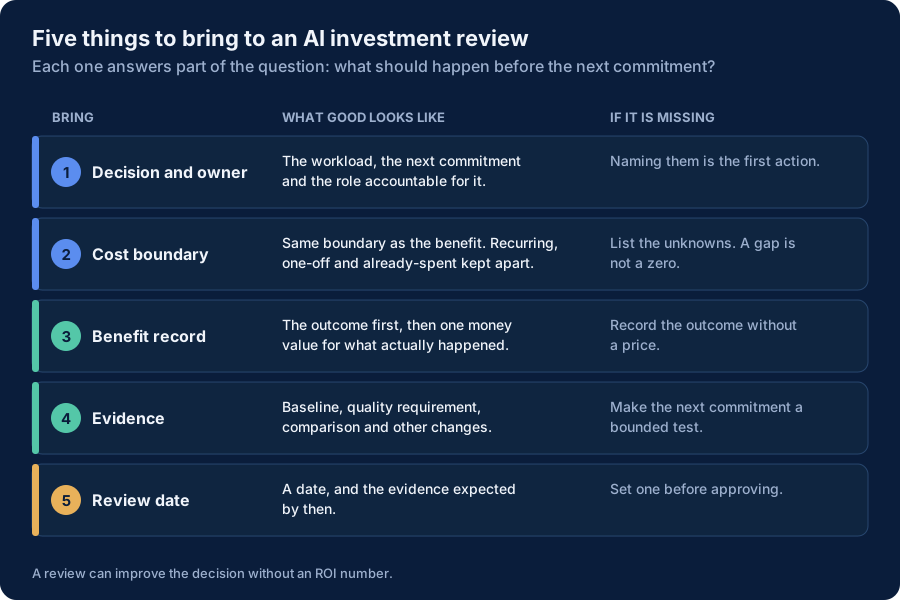
An AI investment review should answer a specific question: what should happen before the next commitment?
That commitment might be a pilot budget, a wider rollout, a renewal or another quarter of operating expenditure. Naming it first keeps the review focused. A decision about 50 additional licences needs a different record from a decision about a new shared platform.
Bring a short description of the workload, the next decision and the role accountable for its outcome. If those cannot yet be named, make that the first action.
Bring a cost boundary
Use the same boundary for cost and benefit. If the benefit covers one workflow, do not compare it with the whole organisation's AI bill. If several teams share a platform, explain how its costs are allocated.
Separate recurring charges, implementation work and money already spent. A setup cost allocated over several years still creates a cash payment at a particular time. An annual comparison should not conceal that distinction.
You do not need a perfect estimate to begin. You need visible assumptions and a list of material unknowns. The AI TCO worksheet sets out the cost lines that most often go missing.
Bring a benefit record
Describe the outcome before converting it into money.
Faster handling, fewer errors and more accepted outputs can each matter. They do not all have the same financial treatment. Time released may become extra capacity, avoided recruitment, less overtime or an improvement in service.
Record what actually happens to it. Avoid adding several monetary descriptions of the same improvement.
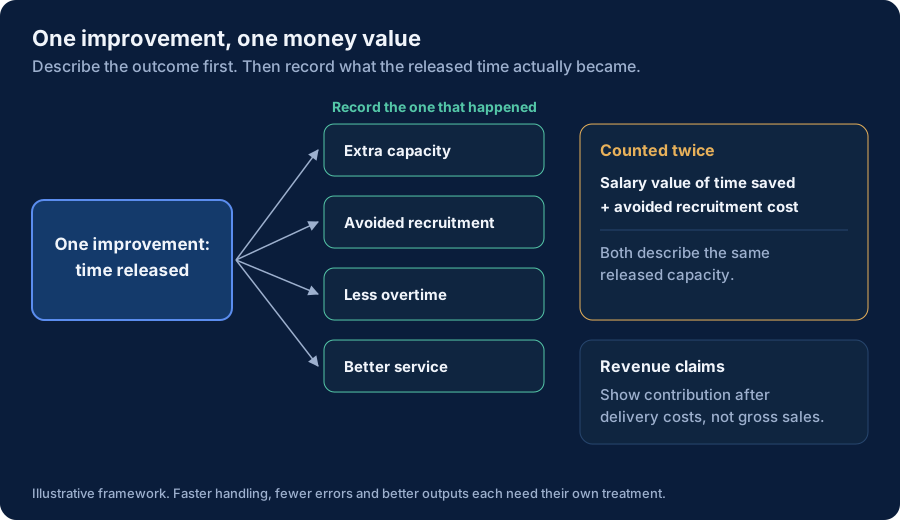
For a revenue claim, show the contribution after the associated delivery costs. A gross sales figure and a cost saving are not directly comparable.
Bring the evidence
Explain the baseline, the quality requirement and the comparison. A user survey may reveal a useful experience. It does not by itself establish how much of a financial change was caused by the tool.
Keep the observation period and other changes visible. If the workflow changed during a platform migration, a staffing change or a seasonal peak, record that context.
When the evidence is weak, the next decision may be a bounded test rather than expansion. Scale, Hold, Redesign, Stop matches the size of the commitment to the strength of the evidence.
Bring an owner and a review date
The review needs someone who can act on the result. That person may need support from finance, engineering, operations or procurement, but the next step should not belong to an undefined group.
Set a date and name the evidence expected by then. "Review next quarter" is less useful than "compare the next four weeks of completed cases and decide whether to issue the remaining licences".
If important information is missing
Do not fill the gap with a precise-looking return. Record the known subtotal, show what is missing and decide how much to commit while the uncertainty is resolved.
A review can be useful without an ROI number. It has improved the decision if it establishes the next piece of evidence, its owner and the commitment that depends on it.
Tools and templates
AI Investment Decision Memorandum
Word template. A seven-part memorandum for a material funding request, built around a proof plan and exit criteria written before the money is spent.
AI TCO worksheet
Excel worksheet. Price an AI use case from pilot to production across seven sheets, including the costs that never reach the model invoice.
AI Benefits Register
Excel template. Track each benefit by type, owner and booking record, so only value that has reached an accepted record counts as realised.